


New Jersey Notary Discipline and Penalties Compliance Risks and Consequences
A New Jersey Notary Public is a state-commissioned public officer. With that commission comes legal responsibility.
Failure to comply with New Jersey notary law may result in discipline, civil liability, financial penalties, or loss of commission.
Understanding the risks of noncompliance is essential to protecting your authority to serve.

Who Oversees New Jersey Notaries?
New Jersey Notaries Public are commissioned under state law and subject to oversight by state authorities.
Complaints regarding misconduct, improper notarization, advertising violations, or statutory noncompliance may be reviewed and investigated.
Because a notary holds public office, violations are treated seriously.
Grounds for Discipline in New Jersey
Disciplinary action may occur if a notary:
-
Fails to maintain a compliant journal
-
Overcharges beyond statutory fee limits
-
Performs improper or incomplete notarial acts
-
Fails to properly verify identity
-
Engages in misleading advertising
-
Suggests attorney-level authority
-
Engages in the Unauthorized Practice of Law
-
Fails to comply with Remote Online Notarization requirements
-
Falsifies or fabricates records
Many violations arise not from intent, but from misunderstanding statutory requirements.


Journal Violations
New Jersey requires a compliant journal for all notarial acts. A paper journal must be permanently bound, contain sequentially numbered pages, and be maintained in chronological order.
New Jersey law also permits electronic journals in appropriate circumstances, provided they meet statutory requirements for security, integrity, and retention.
Journal-related violations may include:
-
Using an unbound paper notebook
-
Using a paper journal without sequentially numbered pages
-
Maintaining multiple concurrent journals improperly
-
Failing to record required statutory elements
-
Incomplete identity verification documentation
-
Leaving blank lines between entries
-
Failing to retain journal records for the required period
-
Using an electronic journal that does not meet security or tamper-evident standards
-
Failure to retain required electronic or audio-visual records for RON transactions
Whether paper or electronic, journal compliance is mandatory.
Improper recordkeeping weakens a notary’s defense in disputes and may significantly increase exposure during an investigation.
Fee Violations
New Jersey sets specific statutory fee limits for notarial acts, including special transaction-based limits in certain real estate matters.
Discipline may result from:
-
Charging more than the allowed amount
-
Misrepresenting service fees as notarial fees
-
Failing to document fees
-
Combining unauthorized services with notarial charges
Fee transparency and accuracy are critical.


Advertising and Misrepresentation
Improper advertising may trigger investigation if a notary:
-
Implies attorney status
-
Advertises immigration legal services without authorization
-
Uses the terms “Notario” or “Notaria” in a misleading manner
-
Suggests authority beyond statutory notarial powers
Misrepresentation in marketing can expose a notary to both discipline and UPL allegations.
See: Advertising
Unauthorized Practice of Law (UPL)
A New Jersey Notary Public may not provide legal advice, draft legal documents, or interpret legal consequences unless separately licensed as an attorney.
Engaging in UPL may result in:
-
Commission discipline
-
Civil penalties
-
Potential criminal exposure in serious cases
Understanding where authority ends is essential.

Remote Online Notarization Violations
RON introduces additional compliance risks, including:
-
Failure to retain audio-visual recordings
-
Improper electronic journal maintenance
-
Technology platform misuse
-
Identity verification errors
Electronic records create permanent documentation of mistakes.


Probable Consequences of Violations
Depending on severity, consequences may include:
-
Commission suspension
-
Commission revocation
-
Formal reprimand
-
Civil liability for damages
-
Financial penalties
-
Reputational harm
In extreme cases involving fraud or intentional misconduct, criminal consequences may apply.
The Complaint Process
Complaints against a New Jersey Notary Public may be submitted to the appropriate state authority.
If a complaint is filed, a notary may be required to:
-
Provide journal records
-
Respond to written inquiries
-
Participate in review or investigation
Accurate documentation and compliance reduce exposure during review.


Many Problems Are Preventable
Most disciplinary issues stem from:
-
Inadequate education
-
Reliance on generic national templates
-
Misunderstanding statutory authority
-
Poor recordkeeping practices
Clear understanding of New Jersey-specific requirements dramatically reduces risk.
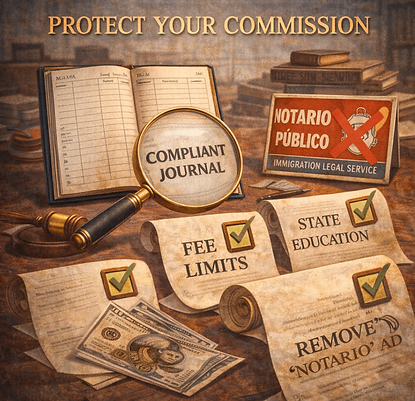
Protecting Your Commission
A New Jersey Notary Public should:
-
Maintain a compliant bound journal
-
Follow statutory fee limits precisely
-
Avoid advertising that implies legal authority
-
Refuse improper requests
-
Seek state-specific education
Professional discipline often results from preventable mistakes.

Education and Risk Mitigation
The New Jersey Notary Association provides education focused specifically on:
-
Statutory authority under N.J.S.A. 52:7-10 et seq.
-
Journal compliance
-
Fee compliance
-
Advertising safeguards
-
UPL boundary recognition
-
RON compliance standards
Professional. Compliant. New Jersey focused.
Protecting your commission begins with understanding your responsibilities.
Remote Online Notarization (RON)
Frequently Asked Questions
Can a NJ Notary lose their commission?
Yes. Commission suspension or revocation may occur if a notary violates statutory requirements.
What is the most common cause of discipline?
Common causes include journal noncompliance, fee violations, and advertising misrepresentation.
Can a notary be sued in New Jersey?
Yes. A notary may face civil liability if negligence causes financial harm.
Does Remote Online Notarization increase risk?
Yes. RON introduces additional technology and retention obligations that increase compliance exposure.
How can I reduce my risk?
Maintain a compliant journal, follow fee limits, avoid legal advice, and pursue structured New Jersey-specific education.

