


Remote Online Notary (RON) Requirements Electronic Notarization in New Jersey
Remote Online Notarization (RON) allows a New Jersey Notary Public to perform certain notarizations using approved audio-visual communication technology.
While electronic notarization is permitted under New Jersey law, it carries significant compliance obligations and technical requirements.
Before offering Remote Online Notarization services, a New Jersey Notary must fully understand statutory authority, recordkeeping requirements, and technology responsibilities.

What Is Remote Online Notarization (RON)?
Remote Online Notarization allows a notary to:
-
Communicate with a signer using real-time audio-visual technology
-
Verify identity through approved remote identification methods
-
Apply an electronic signature and electronic notarial certificate
-
Maintain required electronic records and retention
RON does not expand a notary’s authority. It is simply a different method of performing authorized notarial acts.
The same statutory limits still apply.

NJNA Recommendation: Master Paper Notarization First
The New Jersey Notary Association strongly recommends that a notary become fully comfortable and proficient with traditional paper notarizations before offering Remote Online Notarization services.
The steps required in a standard notarization are already detailed and precise:
-
Proper identification
-
Ensuring signer awareness and willingness
-
Completing a compliant notarial certificate
-
Recording the act in a compliant journal
These steps are not simplified in a remote environment.
In a RON setting, the same complexity exists — but now with an added layer of technology requirements, electronic security standards, identity credential analysis, audio-visual retention, and platform compliance obligations.
Adding technology does not reduce legal responsibility. It increases it.
Legal Authority and Limitations Still Apply
When performing Remote Online Notarization in New Jersey, a notary may not:
-
Provide legal advice
-
Interpret documents
-
Explain legal consequences
-
Select forms for the signer
Remote notarization does not change the boundary between lawful notarial acts and the Unauthorized Practice of Law.


Technology Requirements and Platform Compliance
Remote Online Notarization requires the use of compliant technology platforms capable of:
-
Secure real-time audio-visual communication
-
Identity verification procedures
-
Tamper-evident electronic records
-
Required retention and storage
A notary must understand the platform’s capabilities and ensure it meets statutory standards.
Lack of familiarity with the technology does not excuse noncompliance.
Electronic Journal and Record Retention
RON includes expanded recordkeeping obligations, including:
-
Secure electronic journal entries
-
Audio-visual recording retention
-
Statutory retention periods
-
Protection against unauthorized access
Electronic recordkeeping must be consistent, secure, and compliant.

RON Fees in New Jersey
New Jersey’s remote notarization law requires transparency about fees charged, including an itemized list of fees.
At this time, the New Jersey State Treasurer has not set a specific maximum fee per remote notarization session. For that reason, it is a best practice to have the signer agree to your fee in advance and to present fees clearly and transparently.
Important compliance point: if you charge any separate service fees related to technology, administration, or convenience, keep those fees clearly separated from statutory notarial act fees and do not represent service fees as the statutory notary fee.


Compliance Risks in Remote Notarization
RON presents increased compliance risk because it combines:
-
Identity verification
-
Statutory notarial acts
-
Technology use
-
Electronic recordkeeping
-
Audio-visual documentation
Common risk areas include:
-
Improper identity verification
-
Platform misuse
-
Incomplete electronic records
-
Failure to retain recordings for the required period
-
Advertising electronic services improperly
Because RON transactions are heavily documented, mistakes can become permanent compliance problems.
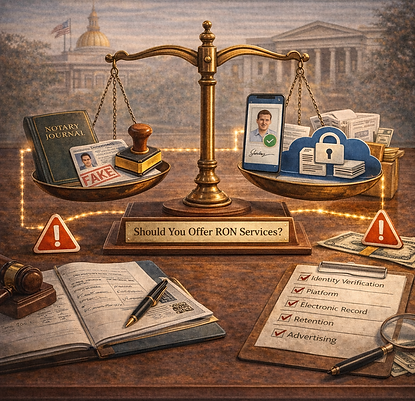
Should You Offer RON Services?
Remote Online Notarization can expand access and convenience, but it is not paper notarization on a screen.
Before offering electronic services, a New Jersey Notary should be completely comfortable with:
-
Standard notarization steps and certificate completion
-
Journal compliance and defensible recordkeeping
-
Fee transparency and lawful billing practices
-
Maintaining boundaries to avoid UPL risk
Technology should never compensate for weak statutory understanding.

Education and Professional Preparation
The New Jersey Notary Association provides New Jersey-specific instruction focused on:
-
Authorized notarial acts
-
Statutory authority limits
-
Journal compliance
-
Fee compliance principles and transparency
-
Risk mitigation
RON does not replace the need for foundational competence. It requires it.
Professional. Compliant. New Jersey focused.
Remote Online Notarization (RON)
Frequently Asked Questions
Does New Jersey allow Remote Online Notarization?
Yes. New Jersey authorizes remote notarization under its notary law framework.
Is RON easier than paper notarization?
No. The same legal requirements apply, and RON adds technology and retention obligations.
Do I need to keep a recording of a remote notarization?
Yes, remote notarizations have audio-visual record retention requirements.
Are RON fees capped in New Jersey?
The State Treasurer has not set a specific maximum fee per remote notarization, and fee transparency is essential.

