


Risks of Unauthorized Practice of Law (UPL)
The Unauthorized Practice of Law, commonly referred to as UPL, is one of the most serious compliance risks facing New Jersey Notaries Public.
Under New Jersey law, a Notary Public is a limited public officer authorized to perform specific notarial acts. A New Jersey Notary is not an attorney and may not provide legal services. When a notary exceeds statutory authority, even unintentionally, it may constitute the unauthorized practice of law.
Understanding the legal boundaries of a New Jersey Notary Public is essential to protecting your commission, your livelihood, and your professional reputation.

What is the Unauthorized Practice of Law (UPL)?
In the State of New Jersey, only licensed attorneys may practice law. The practice of law includes:
-
Providing legal advice
-
Drafting legal documents for another person
-
Selecting legal forms for a client
-
Interpreting legal rights or obligations
-
Representing individuals in court or legal matters
A New Jersey Notary Public may perform authorized notarial acts such as acknowledgments, jurats, and oaths. A notary verifies identity and witnesses signatures. A notary does not interpret documents, give legal guidance, or create legal rights.
If a New Jersey Notary provides services beyond those statutory limits, it may be considered UPL under New Jersey law.
Why UPL Is a Serious Risk for Notaries.
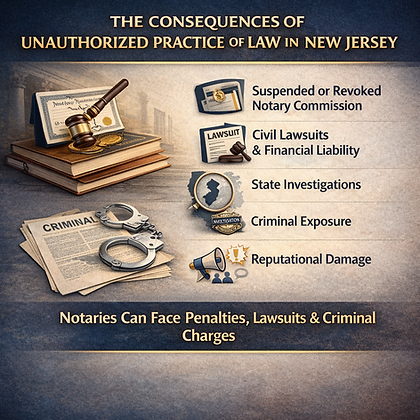
The unauthorized practice of law in New Jersey is not a minor technical violation. It can result in:
-
Suspension or revocation of a New Jersey Notary commission
-
Civil lawsuits and financial liability
-
Investigations by state authorities
-
Criminal exposure in certain circumstances
-
Lasting reputational damage
New Jersey notaries are public officials. The State expects strict adherence to statutory authority. Even well-intentioned assistance can create liability if it crosses into legal advice or legal services.

Common Risk Areas
Many UPL violations occur because notaries misunderstand the limits of their commission. The following areas create heightened risk in New Jersey.
Immigration and “Notario” Advertising
In some countries, a “Notario” is a legal professional. In New Jersey, a Notary Public is not an attorney. Advertising immigration services, document preparation, or legal assistance without a law license can expose a New Jersey Notary to UPL allegations.
Clear, compliant advertising is critical.
Drafting or Completing Legal Documents
If a signer asks, “Can you fill this out for me?” or “Which form should I use?” a New Jersey Notary must not provide legal guidance. Selecting or drafting legal documents for another person may constitute the practice of law.
Explaining Legal Consequences
A New Jersey Notary may describe the type of notarial act being performed. However, explaining the legal effect of a contract, affidavit, or deed goes beyond notarial authority.
Real Estate and Loan Documents
Loan packages and property documents often raise questions. A New Jersey Notary may identify documents but must not interpret terms, explain obligations, or provide advice.
Advertising and UPL
Improper advertising is one of the fastest ways for a New Jersey Notary to attract regulatory attention.
New Jersey notaries must avoid:
-
Representing themselves as legal professionals
-
Using titles that imply attorney status
-
Offering document preparation or legal services without a license
-
Marketing language suggesting legal expertise
A New Jersey Notary Public has a limited statutory role. Advertising must reflect that limited authority.
Misrepresentation, even indirectly, can trigger complaints and disciplinary review.


How New Jersey Notaries Can Protect Their Commission
Protecting your New Jersey Notary commission requires clarity and restraint.
Best practices include:
-
Operate strictly within New Jersey notarial statutes
-
Never provide legal advice
-
Do not draft, select, or complete legal documents for others
-
Maintain compliant advertising practices
-
Refer legal questions to a licensed New Jersey attorney
-
Pursue state-specific notary education
When uncertain, decline the request. It is always safer to refuse a questionable service than to risk engaging in the unauthorized practice of law in New Jersey.
Education and Compliance for New Jersey Notaries
The line between lawful notarial practice and UPL is not always obvious. Many New Jersey notaries were commissioned without comprehensive instruction on statutory limits and advertising compliance.
The New Jersey Notary Association provides education focused specifically on New Jersey notary law, compliance boundaries, and real-world risk mitigation.
State-specific training helps New Jersey Notaries:
-
Understand statutory authority under New Jersey law
-
Identify UPL risk scenarios
-
Avoid advertising violations
-
Protect their commission and professional standing
Professional. Compliant. New Jersey focused.

If you are a New Jersey Notary Public, understanding the unauthorized practice of law is not optional. It is fundamental to lawful practice.
Unauthorized Practice of Law (UPL)
Frequently Asked Questions
What is the Unauthorized Practice of Law in New Jersey?
The Unauthorized Practice of Law (UPL) occurs when a person who is not licensed as an attorney provides legal advice, drafts legal documents for others, or represents individuals in legal matters. In New Jersey, only licensed attorneys may practice law.
Can a New Jersey Notary give legal advice?
No. A New Jersey Notary Public may not provide legal advice unless separately licensed as an attorney. A notary’s role is limited to performing authorized notarial acts such as acknowledgments and oaths.
Is preparing legal documents considered UPL in NJ?
It can be. Drafting, selecting, or completing legal documents for another person may constitute the practice of law in New Jersey. A New Jersey Notary Public must not draft or prepare legal documents unless they are a licensed attorney.
Can a New Jersey Notary prepare immigration paperwork?
A New Jersey Notary Public may not prepare immigration applications or provide immigration legal advice unless separately authorized under federal law. Immigration services may only be provided by licensed attorneys or individuals properly recognized and accredited through the United States Department of Justice Recognition and Accreditation Program.
What happens if a New Jersey Notary engages in UPL?
Consequences may include:
-
Commission suspension or revocation
-
Civil liability
-
Financial penalties
-
Criminal exposure in certain cases
-
Reputational harm
UPL violations are treated seriously because a notary is a state-commissioned public officer.
Does advertising legal services create UPL risk?
Yes. If a New Jersey Notary advertises services that imply legal expertise, document preparation, or immigration legal assistance without proper authorization, it may trigger allegations of the Unauthorized Practice of Law.
Is using the term “Notario” considered UPL in New Jersey?
Using the terms Notario, Notario Publico, Notaria, or Notaria Publica can create consumer confusion because, in many countries, those titles imply attorney-level authority. If the use of those terms suggests legal authority that a New Jersey Notary does not possess, it may expose the notary to UPL allegations.
How can New Jersey Notaries avoid UPL violations?
To reduce risk:
-
Stay strictly within statutory notarial authority
-
Avoid giving legal advice
-
Do not draft or select legal documents
-
Use compliant advertising language
-
Refer legal questions to licensed attorneys
-
Seek state-specific notary education
Understanding statutory limits is the most effective protection against UPL exposure.

